Unlocking the Data Layer for Agentic AI
AI agents are becoming capable of handling increasingly complex tasks with less human intervention. But as agents work for longer and reason across more steps, a new engineering challenge is emerging:
How do we give agents the right information, at the right time, without overwhelming them or exposing our systems to unnecessary risk?
The answer may lie in moving beyond traditional RAG toward a dedicated data and context layer for agents.
Instead of preloading everything an agent might need, this layer allows agents to discover, retrieve, and use relevant information as a task unfolds.
That shift changes not only how agents access data, but also how we think about the architecture behind AI-powered software.
From RAG to dynamic context
Traditional RAG typically follows a straightforward pattern:
Question → Search → Retrieve → Generate
This works well when an application needs to answer a specific question from a relatively predictable knowledge base.
Agentic AI is different.
An agent working on a longer task may need to investigate several sources, make decisions, retrieve additional information, and change its approach along the way. Trying to provide all of that context upfront quickly becomes inefficient.
Instead, the agent needs to navigate the available information and retrieve what it needs when it needs it.
The key shift is:
Don’t give the agent all the context. Give it access to the context.
Once we look at AI this way, the role of the data layer also starts to change. It is no longer simply a place where applications store information. It becomes an interface through which agents can understand and interact with the business.
So, what does this new layer need to do?

What does an agent-ready data layer need?
A useful context layer needs 4 fundamental capabilities.
1. On-demand retrieval
Agents need to find information themselves instead of receiving one fixed package of context.
This can happen through APIs, MCP, CLI tools, or other interfaces. The implementation can vary, but the principle is the same: agents should be able to navigate the data available to them and retrieve only what they need.
2. Current data
Agent decisions are only as reliable as the information behind them.
If an agent is handling a customer issue, for example, it may need the latest order status, payment information, customer history, and company policies.
The context layer therefore needs to stay synchronized with the systems of record.
3. Fast retrieval
Agents may make multiple data requests during a single task.
If every request requires a slow query against an operational system, the agent becomes slow and expensive to use.
The data needs to be available through a layer designed for fast, repeated retrieval.
4. Context that improves over time
Finally, the context layer should become more useful as the system is used.
Decisions, previous interactions, errors, preferences, and other useful information can be captured and transformed into structured context for future tasks.
Together, these capabilities form the foundation of what we can think of as a context engine.
But adding this capability is not simply about introducing another data store. It also affects how the different parts of an AI-powered application work together.
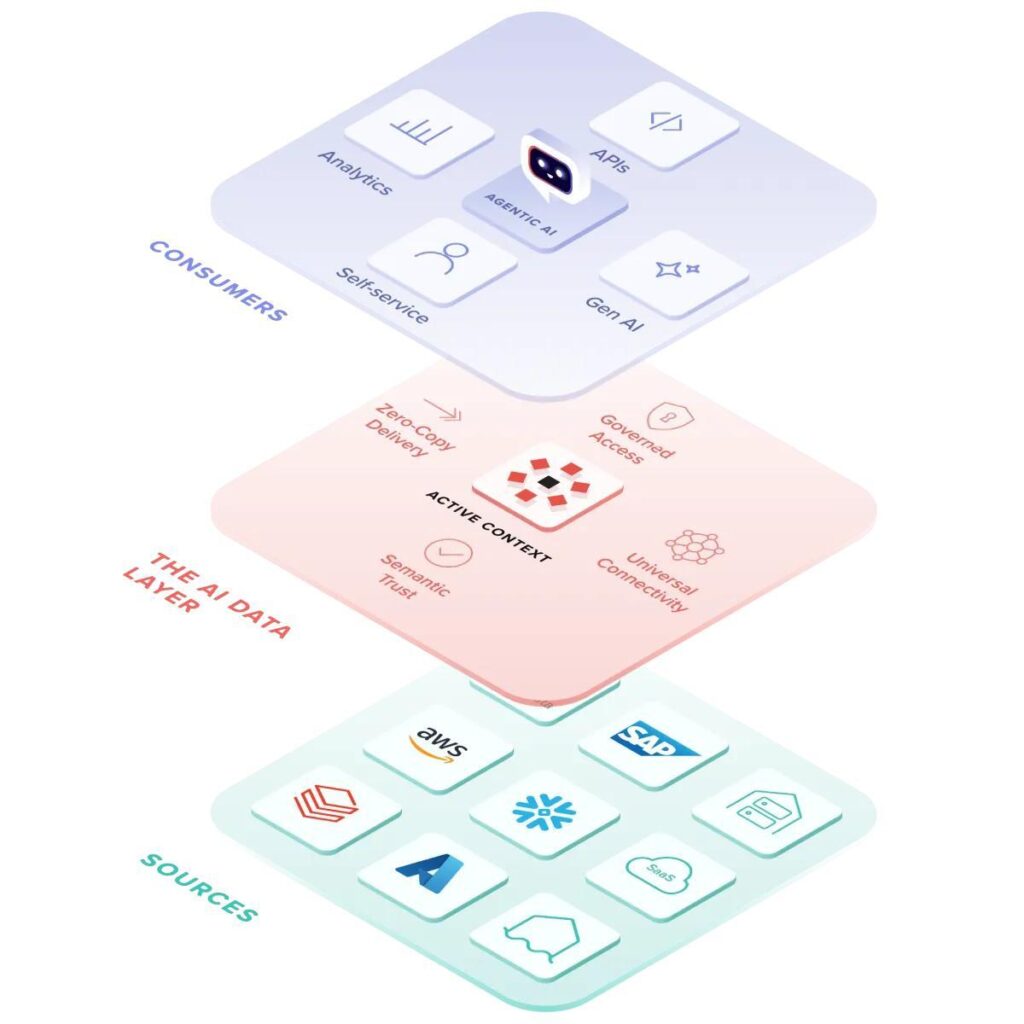
What this means for software architecture
Traditional applications often look like:
Frontend → Application → API → Database
Agentic applications increasingly need another layer:
Agent → Context/Data Layer → Business Systems
This additional layer can handle:
- Data retrieval
- Synchronization
- Semantic modeling
- Access control
- Performance optimization
- Memory
- Agent-specific context
The goal is not to replace existing systems.
Instead, the goal is to create a controlled interface that makes existing business data easier and safer for agents to use.
This also means companies do not necessarily need to rebuild their entire data architecture before experimenting with agentic AI.

Where should companies start?
A practical approach is to start small and build from a real workflow.
Pick One Workflow
Map Required Data
Build a Controlled Layer
Add Semantics
Introduce Pipeline Memory
Measure Outcomes
The data layer may become the next AI advantage
As AI models become better at reasoning, the bottleneck increasingly moves elsewhere.
An agent can only perform well if it can access the right information.
That means the competitive advantage of AI applications may depend not only on which model they use, but on how effectively they connect that model to their data and business systems.
The shift is already becoming clear:
From static context to dynamic context.
From documents to business data.
From search to navigation.
From memory storage to memory pipelines.
From databases built for applications to data layers built for agents.
The future of agentic AI will not be determined by models alone.
It will also depend on the infrastructure that allows those models to understand and act on the world around them.
Building the foundation for agentic AI
For companies exploring agentic AI, the challenge is often not choosing a model. It is connecting AI with existing applications, data, and business processes in a practical way.
At TechSoft, we help companies build the software and data foundations behind AI-powered products — from backend architecture and data integration to AI-driven workflows.
If you are exploring how agentic AI could work with your existing software and data, let’s talk.